Time of the Gentiles
What is the time of the Gentiles? Who are the Gentiles?
The phrase “the time of the Gentiles” is defined for us in Scripture by Luke. In Luke 21:24, Jesus says that Jerusalem shall be trodden down of the Gentiles, until the times of the Gentiles be fulfilled.
“And they shall fall by the edge of the sword, and shall be led away captive into all nations: and Jerusalem shall be trodden down of the Gentiles, until the times of the Gentiles be fulfilled.” (Luke 21:24, KJV 1900)
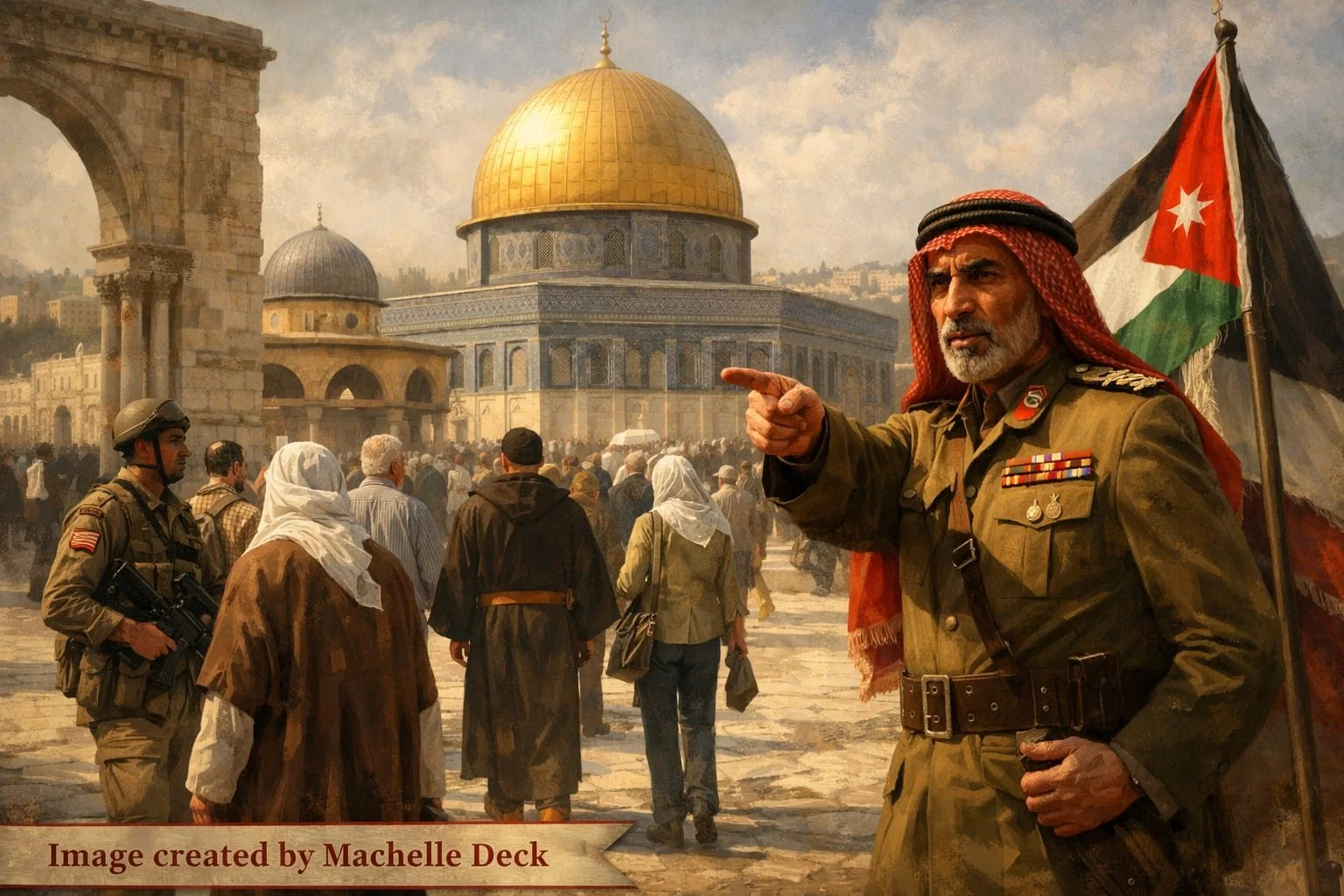
The expression “trodden down” is a figure of speech that conveys the idea of domination and control. It describes a period in history when non Israelite nations will walk upon, live in, and govern the land of Jerusalem. Luke is describing a prophetic period in which Gentile powers would rule over Jerusalem, and he also makes clear that this period will eventually come to completion.
Because Jesus says this time will be fulfilled, there must be an Old Testament prophecy that defines the length and nature of this period, as well as identifies which Gentile powers would play a role in ruling over Jerusalem. Jesus is speaking prophetically, pointing forward through history toward events that will continue all the way until His second advent. According to this prophecy, Jerusalem will remain under Gentile domination until the time when Christ returns and establishes His rightful rule.
how long?
“And one said to the man clothed in linen, which was upon the waters of the river,
How long shall it be to the end of these wonders?” (Daniel 12:6, KJV 1900)
“And I heard the man clothed in linen, which was upon the waters of the river, when he held up his right hand and his left hand unto heaven, and sware by him that liveth for ever that it shall be for a time, times, and an half; and when he shall have accomplished to scatter the power of the holy people, all these things shall be finished.” (Daniel 12:7, KJV 1900)
Before we can answer the question of how long the time of the Gentiles lasts, we must first answer who the Gentiles are. That is the proper order, because the timeline is tied to national identity, rulership, and governance. If we do not first identify the people involved, then the length of the prophecy cannot be understood correctly.
So, who are the Gentiles, and who are the Israelites?
This is especially important because modern readers look at Jerusalem today, see people called Jewish living in the land, and naturally wonder if the prophecy is fulfilled because those there claim to be of Israelite descent. Just because they call themselves “Jewish” does not prove descent but nationality. Just like a person living in Florida may be called a Floridian, but that does not tell you his ancestry.
the gentiles
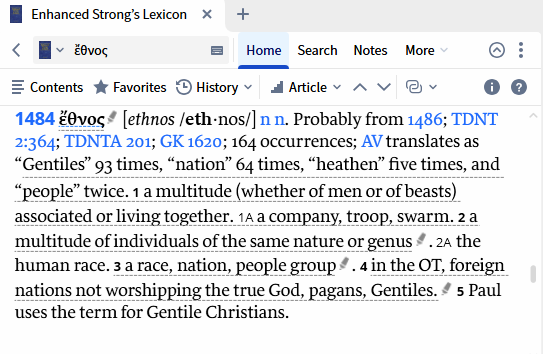
In the Bible, the term Gentiles refers to the non-Israelite nations of the world. The Greek word used in the New Testament is ethnos, which simply means nations or peoples.

Therefore, to understand the prophecy, we must also identify who the Israelites are, and whether a modern population living in the land of Israel necessarily proves descent from ancient Israel. Sometimes people are identified by the land they live in, and not necessarily by their bloodline or heritage. In the same way, a person living in the land of Judah may be called Jewish in a geographic or national sense, while that label by itself does not automatically prove descent from the tribe of Judah.
gentile rule of Jerusalem
According to the prophecy, the tribes were not to remain continuously in the land or return to the land until Jesus returns and gathers them together.
God said to Israel:
“Therefore will I cast you out of this land into a land that ye know not, neither ye nor your fathers, and there shall ye serve other gods day and night, where I will not shew you favour.” Jeremiah 16:13, KJV 1900
This establishes that Israel would be removed from the land and scattered abroad.
Scripture also tells us that there will be a future reunion and return. Jeremiah says:
“In those days the house of Judah shall walk with the house of Israel, and they shall come together out of the land of the north to the land that I have given for an inheritance unto your fathers.” Jeremiah 3:18, KJV 1900
This verse is very important because it shows that the full restoration has not yet been completed in the prophetic sense until Judah and Israel come together. The prophecy is not merely about people living in the land, or even some returning in the year 1948. In fact, there is another prophecy about an evil nation ruling in Israel by Joel the prophet.
“Awake, ye drunkards, and weep; And howl, all ye drinkers of wine, Because of the new wine; for it is cut off from your mouth. For a nation is come up upon my land, Strong, and without number, Whose teeth are the teeth of a lion, And he hath the cheek teeth of a great lion.
He hath laid my vine waste, And barked my fig tree: He hath made it clean bare, and cast it away; The branches thereof are made white. Lament like a virgin girded with sackcloth for the husband of her youth.” (Joel 1:5–8, KJV 1900)
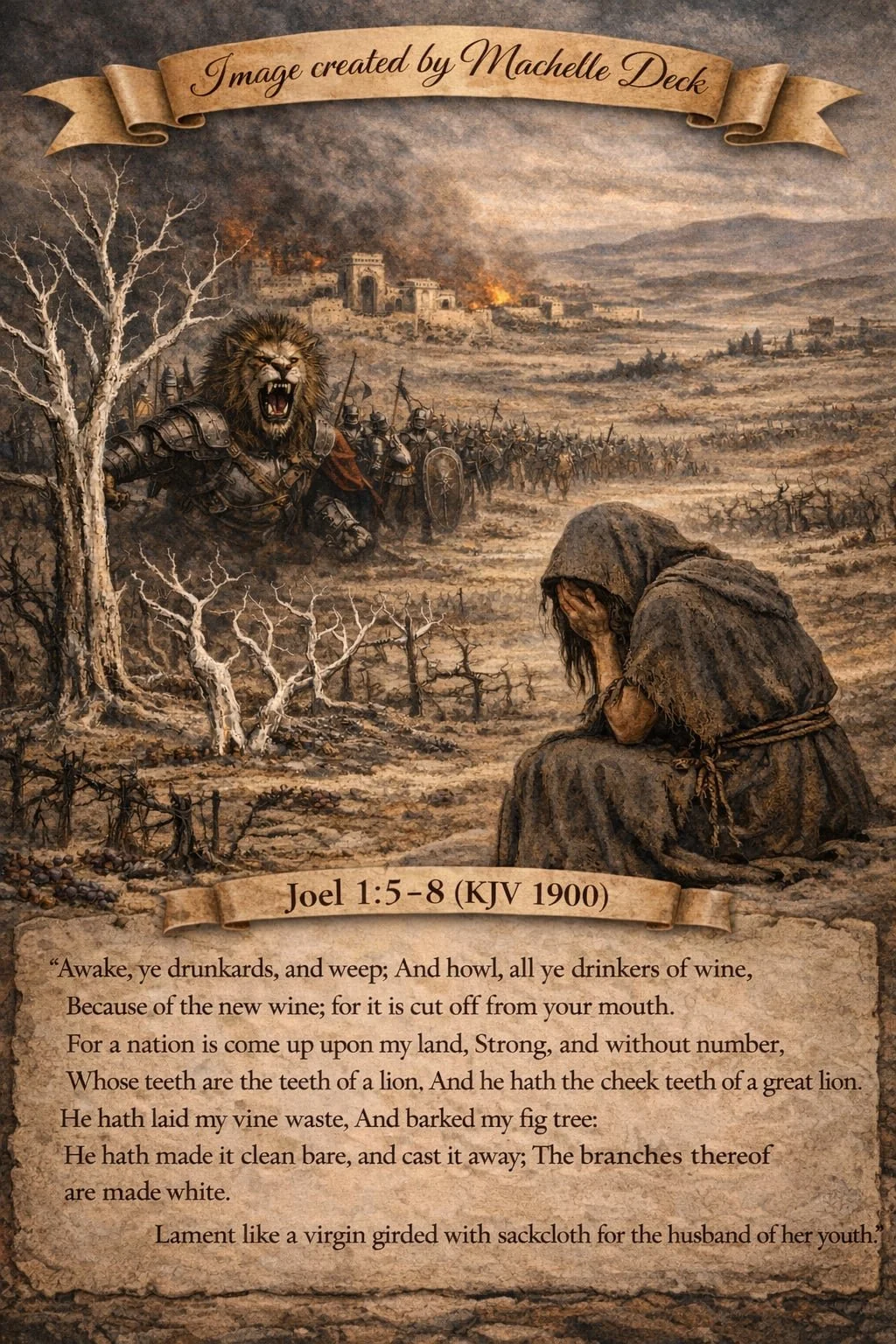
This means the question is larger than just a “return” to the land. It’s also including a "false” return to the land, i.e. 1948, the false return where the fig tree is “barked”; therefore, 1948 cannot be the termination of the “time of the Gentiles”. Gentile rule of Jerusalem still continues to this day.
Going back to the travels of the tribes of Israel and where they went, what names they bore through history, and how God said He would bring them back. All yet future, even today.
That is why historical records of the travels and migrations of the tribes of Israel matter so much in this study. As people moved across time and across lands, they were often known by the names they chose, or by the names given to them in the records of the nations. If we follow those names alongside the Bible verses that describe those names and where Israel would go, i.e. “the land of the NORTH”, we begin to trace a prophetic trail. In other words, the Bible gives the prophetic direction, and history preserves the footprints.
The time of the Gentiles, then, is a question of who governs Jerusalem and the land of Israel, and whether that rule belongs to the covenant people in their full prophetic restoration, or to Gentiles. The prophecy is related to rulership and governance over the land. That’s why Daniel lists a series of monarchies that will rule over the land of Israel up until the rise of the evil nation in Israel (Joel 1:6-7) and lastly the arrival of the false christ (antichrist/satan).
By tracking people across time, using the names found in historical documents and the destinations described in Scripture, we can begin to understand who the true tribes of Israel are and where they went, and what nations they formed. This gives them a prophetic identity as well, because the Bible talks about the nations of Israel and their final destiny many times.
All of this together forms the basis for understanding the time of the Gentiles, because that time is ultimately about foreign rulership over the land of Israel, even evil control over the land, and then finally God’s restoration of His people according to His Word.
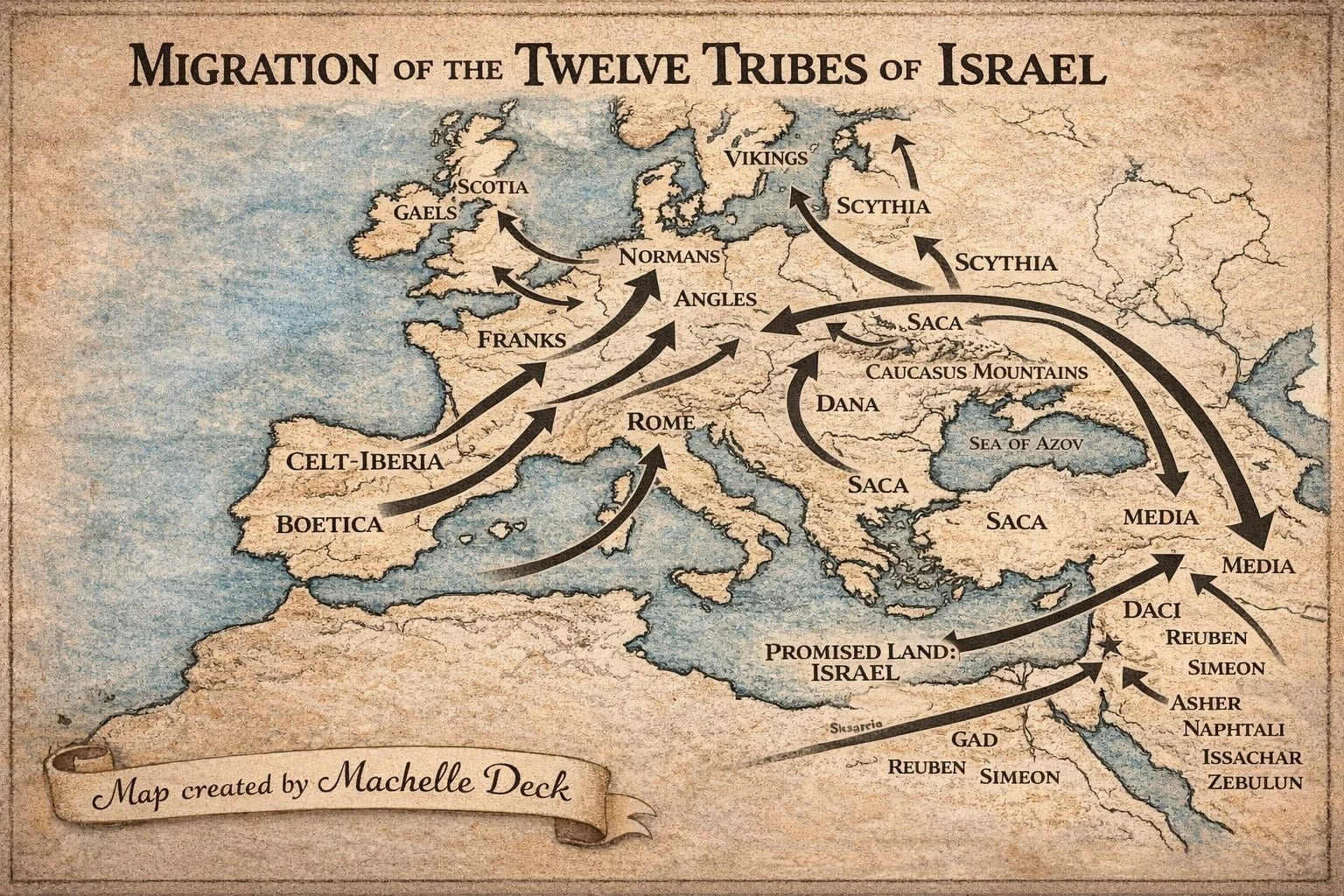
This is a simplification of the information given by E. Raymond Capt in his book “Jacob’s Pillar”. check resources
Throughout Scripture these Gentiles are often distinguished from the covenant people of Israel. In some places they are also associated with what the Bible calls the mixed multitude, people from many nations who interact with Israel and appear throughout the Biblical narrative. We first see this concept clearly during the Exodus, when a mixed multitude came out of Egypt alongside the children of Israel. From that point forward, the nations continually appear throughout the Biblical story, interacting with Israel politically, spiritually, and prophetically. Their presence continues throughout the prophets, the Gospels, and into the book of Revelation.
The Scriptures show that the Gentile nations play a role in God’s prophetic plan on both a national and global scale. Their involvement reaches all the way to Revelation 11, where we again see the same language used by Jesus in Luke. There the prophecy says that the Gentiles will tread down the holy city and the Temple Mount for a specific period of time.
“But the court which is without the temple leave out, and measure it not; for it is given unto the Gentiles: and the holy city shall they tread under foot forty and two months.” (Revelation 11:2, KJV 1900)
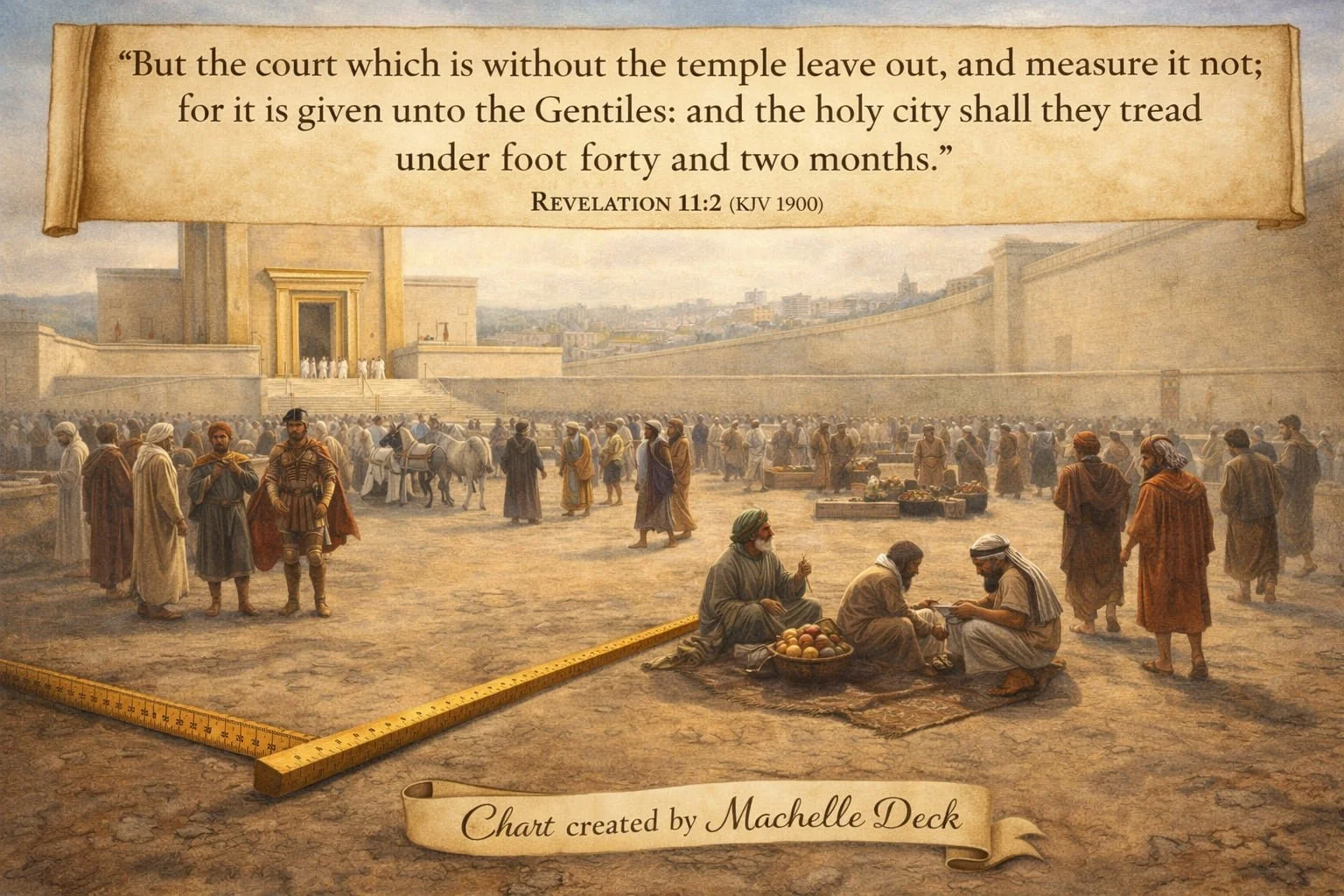
This demonstrates that the theme of Gentile domination over Jerusalem runs from the Old Testament prophets through the New Testament and into the final prophetic events.
Yet the Bible also reveals an important spiritual principle concerning the relationship between Israel and the nations. While the Gentiles exist as separate nations in prophecy, individual Gentiles are not excluded from God’s covenant blessings. Through faith they can be grafted into the vine of Israel, receiving the spiritual promises that God has offered through His covenant.
“Give none offence, neither to the Jews, nor to the Gentiles, nor to the church of God:” (1 Corinthians 10:32, KJV 1900)
“Where there is neither Greek nor Jew, circumcision nor uncircumcision, Barbarian, Scythian, bond nor free: but Christ is all, and in all.” (Colossians 3:11, KJV 1900)
“And they also, if they abide not still in unbelief, shall be graffed in: for God is able to graff them in again.” (Romans 11:23, KJV 1900)
Even the tribes of Israel, who have been pruned off the tree, can be grafted back into the tree as it is written in Romans 11:17-24.
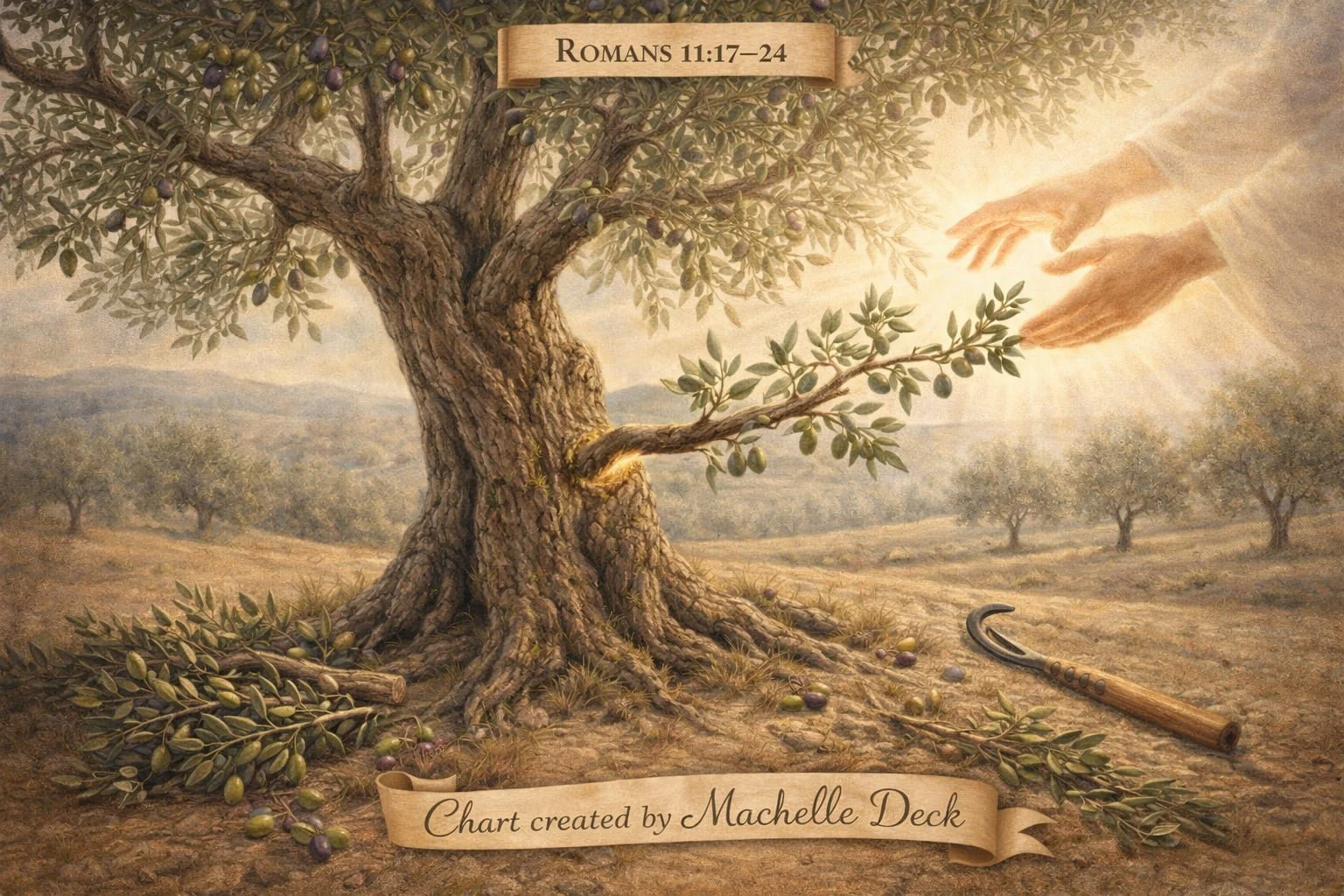
At the same time, Scripture teaches that physical descent alone does not guarantee blessing. Even those who come from the seed line of Israel can be cut off or pruned from the vine if they reject Jesus Christ. This rejection is described in Scripture as the spirit of Antichrist, because it denies the Messiah whom God sent.
“Who is a liar but he that denieth that Jesus is the Christ? He is antichrist, that denieth the Father and the Son. Whosoever denieth the Son, the same hath not the Father: (but) he that acknowledgeth the Son hath the Father also.” (1 John 2:22–23, KJV 1900)
Therefore, the Bible presents a balanced picture. Gentile nations have a prophetic role in the governance of Jerusalem, while individual Gentiles can enter into the spiritual blessings of Israel through faith. Conversely, those of Israel who reject Christ can be removed from those blessings. This interplay between Israel and the nations forms an important foundation for understanding the prophetic concept known as “the time of the Gentiles”.
The Old Testament prophecy that most clearly defines the length and nature of Gentile rule over Jerusalem is found in the book of Daniel. In harmony with Jesus’ words in Luke 21:24, Daniel reveals that a succession of Gentile kingdoms would dominate the world stage during the period often called “the times of the Gentiles.” According to the interpretation summarized by Dr. E. W. Bullinger, the prophetic framework of Daniel shows that God revealed, in advance, the rise and fall of all the major Gentile empires that would rule the known world until the final establishment of God’s kingdom. This prophetic outline begins in Daniel chapter 2, where King Nebuchadnezzar receives a dream of a great statue composed of several different materials, each representing a successive kingdom.
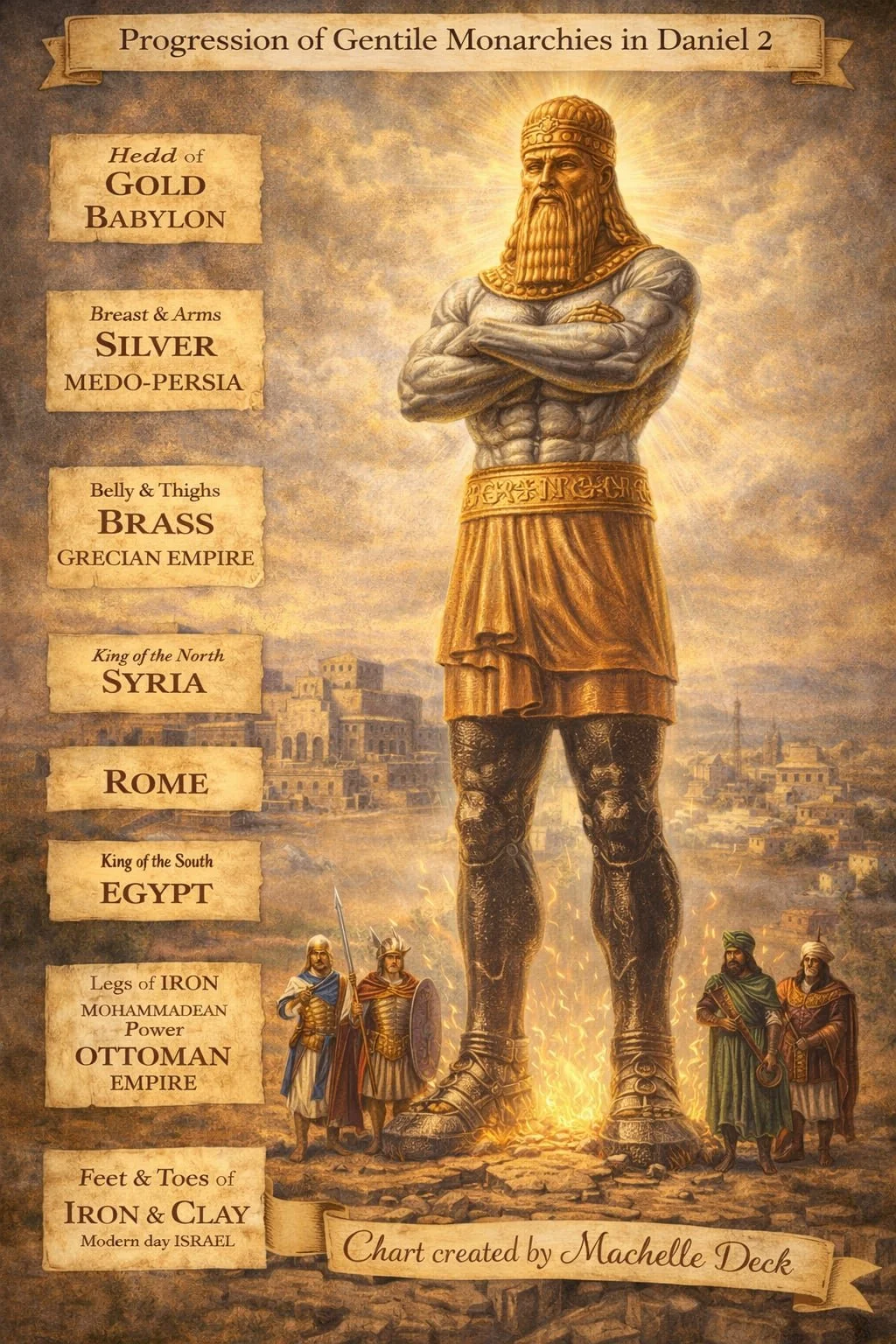
In Bullinger’s synopsis of the book of Daniel, the statue represents a progression of Gentile monarchies, beginning with Babylon and extending through history to the final global phase of Gentile rule. The head of gold represents Babylon under Nebuchadnezzar, the first of the great Gentile world powers after the kingdom of Judah fell. The breast and arms of silver represent the Medo-Persian kingdom, which followed Babylon and ruled the known world.
The belly and thighs of brass represent the Grecian empire lead by Alexander the Great (divided into 4:Syria, Egypt, Rome, & Turkey).
The legs of iron represent the Mohammadean power, a kingdom characterized by great strength and crushing authority, as is demonstrated by the Ottoman empire.
In this chart below, you can quickly see the succession of Gentile kingdoms that have been and still are (even after 1948) ruling over Jerusalem.
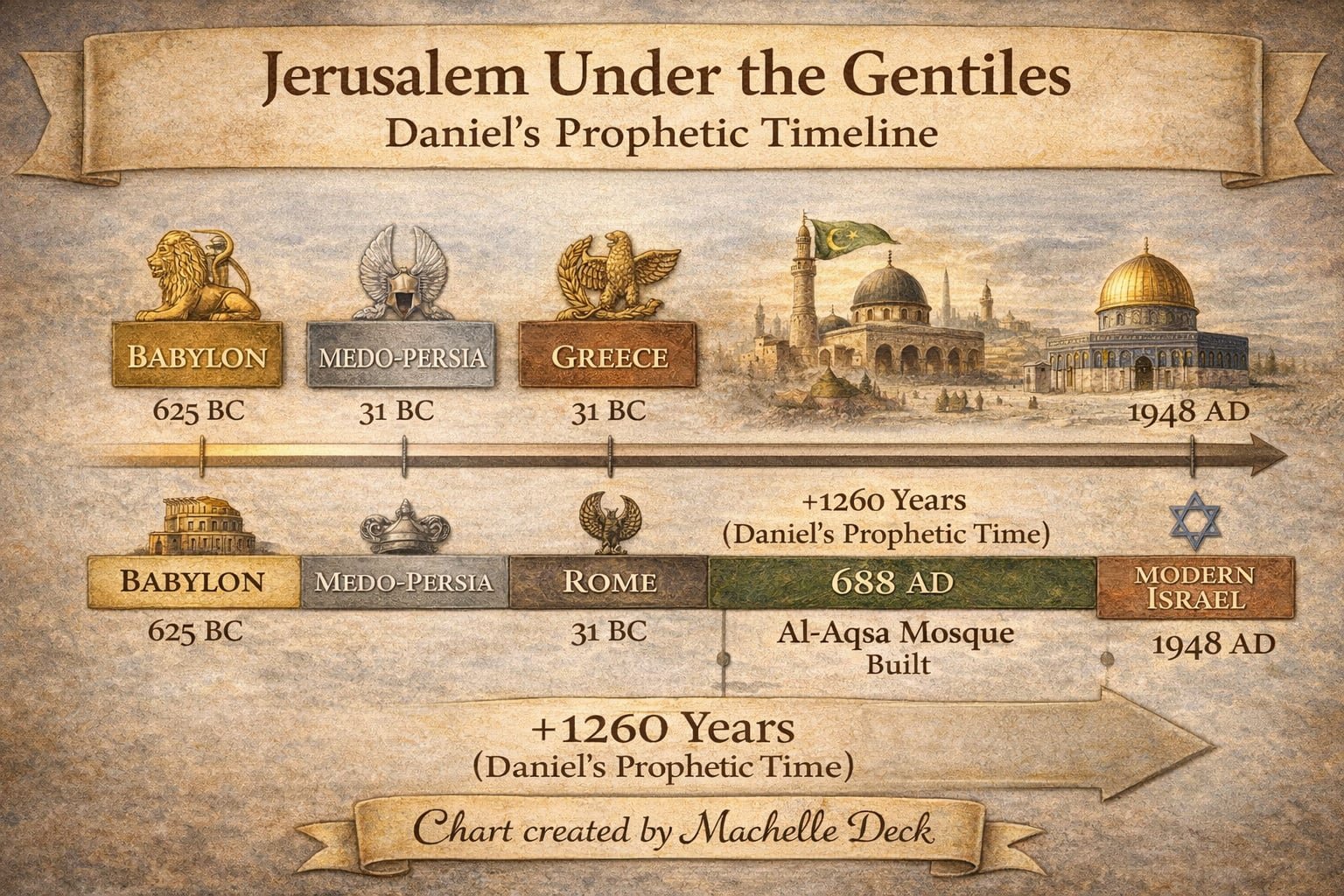
Chart inspired by E.W. Bullinger’s chart on p. 189 of Numbers in Scripture and p. 185 of Witness of the Stars (connect resource here)
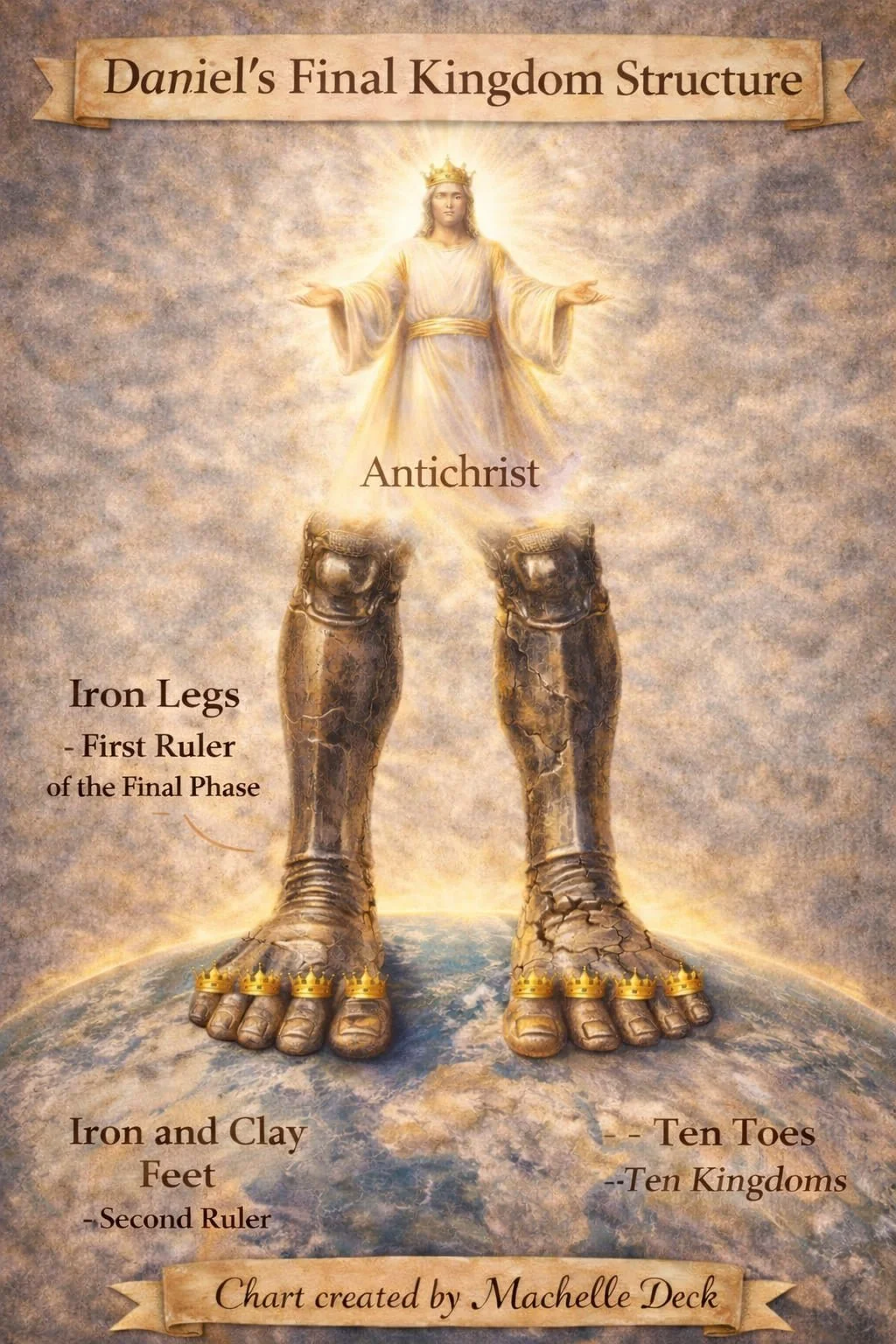
Finally, the statue concludes with feet and toes made of iron mixed with clay, representing the final phase of Gentile rule before the return of Christ. This is AFTER what we have now in the state of Israel.
This prophetic statue shows that Gentile dominion over the earth develops from ancient regional empires into a global system in the final stage, symbolized by the feet and toes. In this interpretation, the modern era corresponds to this final phase. The mixture of iron and clay portrays a fragile but powerful confederation, a conglomerate rule that attempts to combine elements that cannot truly bond together. In the context of this study, the mixture is understood to represent two seed lines, one originating from the line of Cain and another from the Gentile nations. The resulting system is unstable and divided, yet it still exercises control over the world and over Jerusalem during the closing phase of the times of the Gentiles.
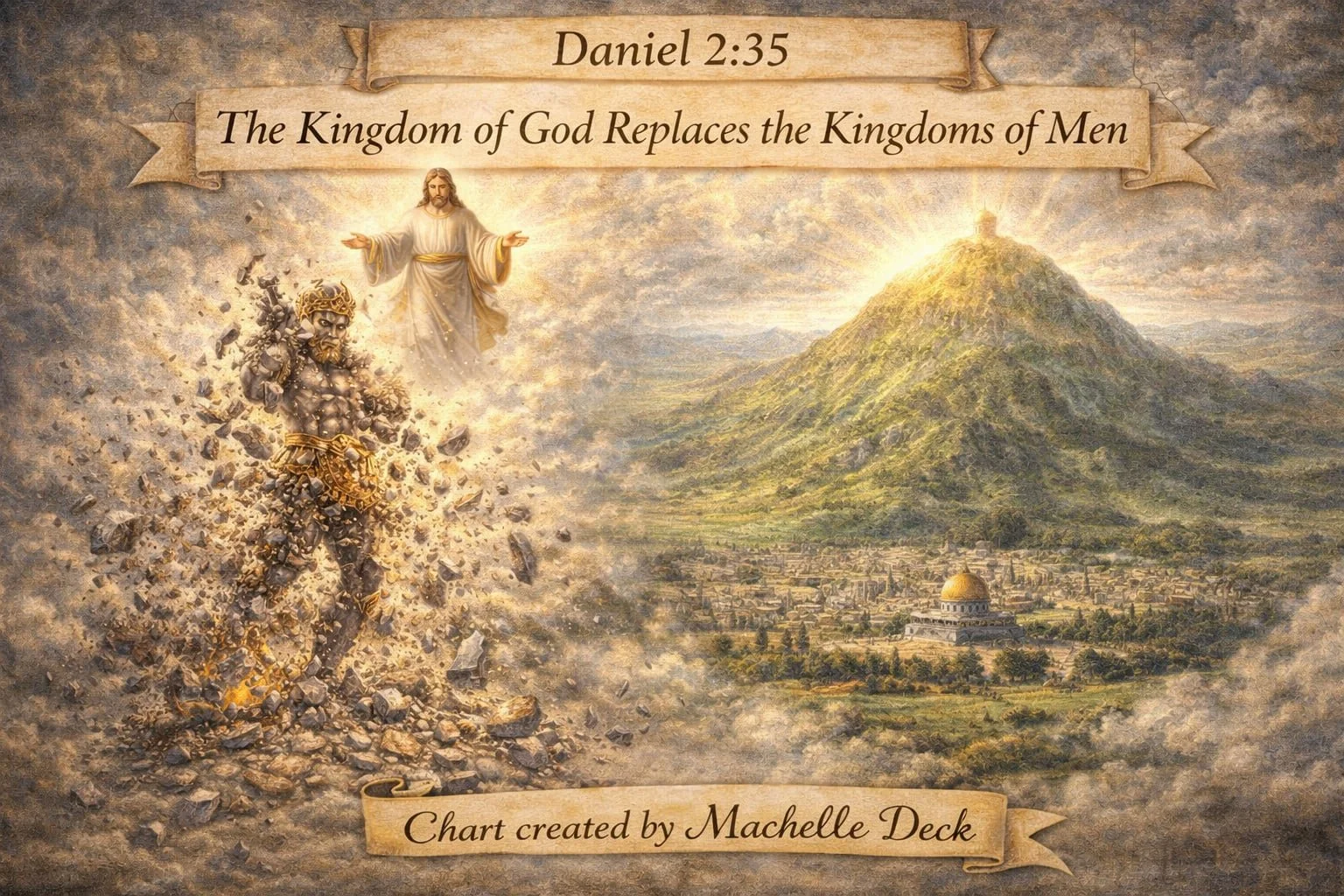
This interpretation emphasizes that true Israel has not yet returned in its full prophetic sense. The present political state of the land does not represent the complete restoration promised in Scripture. According to the prophetic picture in Daniel, the true restoration of Israel will not occur until the moment when the kingdom of God replaces all Gentile rule. That moment is depicted in the dream when a stone cut out without hands strikes the statue at its feet.
The stone represents the kingdom of God established by Christ at His return. When the stone strikes the statue, the entire structure collapses and is ground to powder, symbolizing the complete end of Gentile dominion and the beginning of God’s righteous kingdom.
“Forasmuch as thou sawest that the stone was cut out of the mountain without hands, and that it brake in pieces the iron, the brass, the clay, the silver, and the gold; the great God hath made known to the king what shall come to pass hereafter: and the dream is certain, and the interpretation thereof sure.” (Daniel 2:45, KJV 1900)
“I beheld till the thrones were cast down, and the Ancient of days did sit, whose garment was white as snow, and the hair of his head like the pure wool: his throne was like the fiery flame, and his wheels as burning fire. A fiery stream issued and came forth from before him: thousand thousands ministered unto him, and ten thousand times ten thousand stood before him: the judgment was set, and the books were opened. I beheld then because of the voice of the great words which the horn spake: I beheld even till the beast was slain, and his body destroyed, and given to the burning flame.” (Daniel 7:9–11, KJV 1900)
Within the statue imagery, the ten toes represent the final configuration of global authority before the second advent. These ten toes correspond to ten kingdoms or nations, forming the final stage of Gentile rule. In this interpretation, the tenfold structure also represents Satan’s global system, operating through the Antichrist. The rule is described as top heavy, originating from the head and extending downward through successive empires until it reaches its final divided state in the toes.
The mixture of iron and clay in this last stage can also be viewed as a picture of supernatural presence combined with human government, suggesting that the final global system will involve both earthly rulers and supernatural angels working together in the presence of humankind.
“And whereas thou sawest iron mixed with miry clay, they shall mingle themselves with the seed of men: but they shall not cleave one to another, even as iron is not mixed with clay.” (Daniel 2:43, KJV 1900)
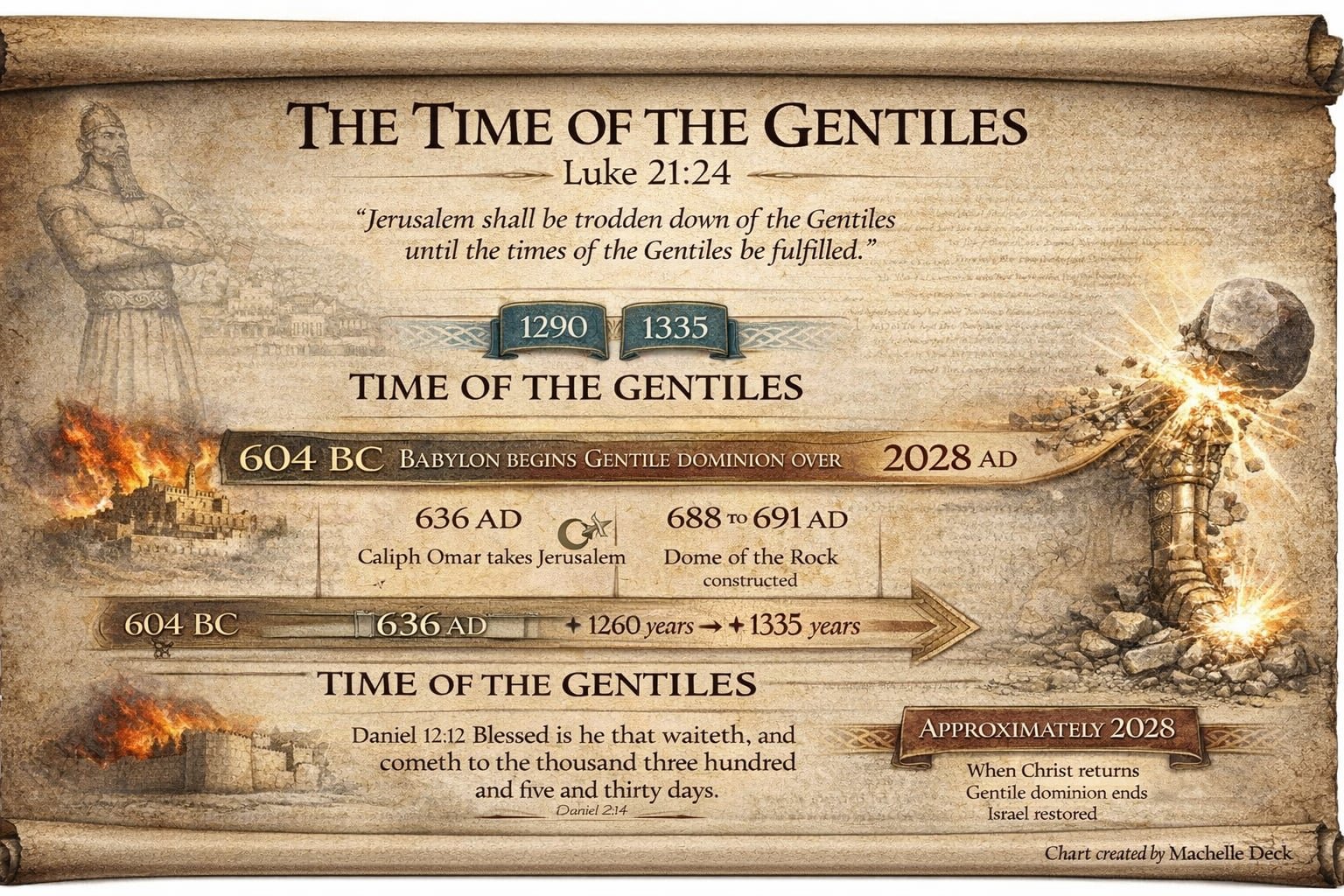
The Time of the Gentiles is the period during which Jerusalem is under Gentile dominion, as Christ described in Luke 21:24, and our study traces this timeline beginning with the approximate date of 604 BC, when Nebuchadnezzar king of Babylon came unto Jerusalem and besieged it, as recorded in Daniel 1:1,
“IN the third year of the reign of Jehoiakim king of Judah came Nebuchadnezzar king of Babylon unto Jerusalem, and besieged it.” (Daniel 1:1, KJV 1900)
marking the start of Gentile rule over the holy city. From that beginning point we follow the prophetic timeline through history, noting major events such as the Muslim conquest of Jerusalem in 636 AD and the construction of the Dome of the Rock between 688 and 691 AD, which continued the reality of Gentile possession of the holy place, and then we move to the conclusion given at the very end of the book of Daniel, where Daniel 12:12 declares,
“Blessed is he that waiteth, and cometh to the thousand three hundred and five and thirty days.” (Daniel 12:12)
When the whole book of Daniel is viewed together, from its opening historical marker in chapter 1 to its closing prophetic statement in chapter 12, the chart demonstrates the full span of Gentile dominion and points to the moment when that period ends, which ultimately coincides with the destruction of the Gentile image and kingdoms described in Daniel 2, when the true Christ returns at the last trump and the stone from heaven strikes the image, ending Gentile rule and establishing God’s kingdom. As watchmen we do not claim an exact date, but we carefully compare the scriptures with the historical timeline and observe that the prophetic counts point toward a window of time approaching approximately 2028, understanding that God works according to His own timing and that events often unfold over a period of years, just as it took time for the Dome of the Rock to be constructed after Jerusalem fell under Islamic rule; therefore we watch within a three to four year window, recognizing that Scripture repeatedly instructs believers to watch for the signs while trusting that God will fulfill His promises precisely according to His Word.
“For these be the days of vengeance, that all things which are written may be fulfilled.” (Luke 21:22, KJV 1900)
As we close this study, we are reminded of the example of the prophets who carefully searched the Word of God to understand His times and purposes. The prophet Ezekiel himself was known to count the years of the Jubilee, faithfully marking the times that God had established. In the same spirit, we sit with the Scriptures before us, examining every word and comparing every passage, seeking to understand the timeline God has revealed. Just as Ezekiel labored over the details with the guidance of the Spirit of God, so we trust that the Holy Spirit leads those who diligently study His Word. Our task is not to force conclusions, but to watch, to study, and to trust that God fulfills His promises exactly as He has spoken. And so we close this study with the same posture of the watchman, patiently observing the signs, carefully noting the Scriptures, and resting in the assurance that the Lord will bring all things to pass according to His perfect timing.