
THE BOOK OF DANIEL
chapter 3
According to the Septuagint OLD GREEK manuscripts, kept hidden from English eyes for thousands of years until 2012!
This is a presentation of the book of Daniel with commentary to help establish the timing of the book, and historical context. I also look at the themes and usage of different words used in context. The translation is from Logos Bible Software where it is called the Lexham English Septuagint (LES - copied with permission from Logos Bible Software).
Brannan, R., Penner, K. M., Loken, I., Aubrey, M., & Hoogendyk, I., eds. (2012). The Lexham English Septuagint (Da 2:35). Lexham Press.
scripture
3 LES
3:1 In the eighteenth year of King Nebuchadnezzar, when he was governing cities and countries and even all the inhabitants on the earth, from India to Ethiopia, he constructed a golden image, its height was sixty cubits and its width was six cubits. And he set it up in the plain that encircles the region of Babylon.
3:2 Now Nebuchadnezzar, king of kings and ruler of the whole inhabited world, sent to gather together all the peoples and tribes and tongues, satraps, commanders, regional governors and highest officials, administrators, and those in authority according to each province and all those according to where they lived to come to the dedication of the image of gold that King Nebuchadnezzar had set up.
3:3 Then the consuls, commanders, governors, those going before the great kings in authority, and all the rulers of countries gathered so as to come to the consecration of the image that King Nebuchadnezzar had established. And those specified in writing stood before the image that Nebuchadnezzar had established.
3:4 And the herald made a proclamation to the peoples, “You are charged, O nations and countries, peoples and languages,
3:5 whenever you hear the sound of the trumpet, pipe, and cithara, stringed instrument and lyre, psaltery, and every kind of musical instrument, you are to fall down and worship the golden image that King Nebuchadnezzar set up.
3:6 Now, anyone who does not fall down and worship, in that same hour they will cast him into the furnace that is aflame with fire!”
3:7 And at the appointed time, when the sound of the trumpet, pipe and also the lyre, stringed instrument, and also the harp and every sound of musical instruments was heard by all the peoples, having prostrated themselves, all the peoples, tribes, and languages did obeisance to the golden image that King Nebuchadnezzar had set up in front of them.
3:8 At that time, after coming forward, some Chaldeans accused the Judeans.
3:9 And taking up their case, they said to King Nebuchadnezzar, “O lord the king, live forever!
3:10 You, O king, commanded and so ruled that any person who hears the sound of the trumpet, pipe, and also triangular stringed instrument, the lyre, and psalter, and every sound of musical instruments, must fall down and worship the golden image.
3:11 And whoever does not fall down and worship will be thrown into the furnace aflame with fire.
3:12 Now there are certain men, Judeans whom you have placed over the province of Babylon, Shadrach, Meshach, and Abednego, those men did not honor your command, and they did not serve your idol and they did not worship your golden image that you set up.”
3:13 Then Nebuchadnezzar, inflamed with rage, commanded them to lead in Shadrach, Meshach, and Abednego. Then the men were led to the king.
3:14 And when King Nebuchadnezzar saw them, he said to them, “For what reason, Shadrach, Meshach, and Abednego, did you not serve my gods nor worship the golden image that I set up?
3:15 And now, if you are prepared, at the same time that you hear the trumpet, pipe, and also the lyre, triangular stringed instrument, and psalter and harmony and every sound of musical instruments, fall down to reverence the golden image that I have set up. But if not, then know that if you do not worship it, immediately you will be thrown into the furnace aflame with fire, and what manner of god will rescue you from my hands?”
3:16 But responding, Shadrach, Meshach, and Abednego said to the king, “O King Nebuchadnezzar, we have no need to reply to you concerning this command.
3:17 There is indeed one god in heaven, our Lord, whom we fear, and who is able to deliver us out of the burning of the fiery furnace and out of your hands, O king; he will rescue us.
3:18 And then it will be clear to you, O king, that we will neither engage your idol in worship, nor are we going to worship your golden image that you have set up!”
3:19 Then Nebuchadnezzar was filled with wrath, and the features of his face were altered upon Shadrach, Meshach, and Abednego. And he gave an order to ignite the furnace seven times beyond what it was accustomed to kindle it.
3:20 And he ordered strong men from those in his army, after binding their feet, to throw Shadrach, Meshach, and Abednego into the furnace aflame with fire.
3:21 Then those men were bound with their feet tied together, and having their sandals, and their headdresses upon their heads, along with their clothing, they were thrown into the burning furnace of fire.
3:22 And since the command of the king was so urgent, and the furnace was heated more than was usual by seven times, and the men who had been appointed and had bound them hand and foot and had brought them up to the furnace cast them into it.
3:23 Therefore, the flame going out from the furnace set on fire the men hindering those with Azariah and killed them. But they were preserved.
3:24 In this manner, therefore, prayed Hananiah and Azariah and Mishael, and they sang to the Lord when the king commanded them to be thrown into the furnace.
3:25 And standing still, Azariah prayed in this manner, and when he opened his mouth he acknowledged the Lord together with his companions in the midst of the blazing fire, the furnace having been ignited by the Chaldeans exceedingly with fire, and they said,
3:26 “Blessed are you, O Lord, God of our fathers, and to be praised, and glorious is your name into the ages!
3:27 For you are just concerning all the things you have done to us, and all your works are true, and your paths are right, and all your judgments are truthful.
3:28 And you have carried out accurate judgments according to all the things you have brought upon us, and upon your holy city, the city of our fathers, Jerusalem, because in truth and in justice you have done all these things on account of our sins.
3:29 For we have sinned in every way, and acted lawlessly by moving away from you, and we have done grievous wrong in every way.
3:30 And we have not listened to the commandments of your law. Neither have we closely observed nor have we acted according to what you commanded to us, in order that it may go well for us.
3:31 And now, everything, whatsoever you have brought against us, and everything, whatsoever you have done to us, you have acted in truthful judgment.
3:32 Now you have given us over into the hands of our enemies, lawless and hostile rebels, and to an unrighteous king, even to the most wicked king in all the earth.
3:33 And so now it is not permitted for us to open our mouth. Dishonor and disgrace has come to your servants, even those worshiping you.
3:34 Do not utterly give us over on account of your name, and do not turn from your covenant.
3:35 And do not remove your mercy from us on account of Abraham, the one loved by you, and on account of your servant Isaac and your holy one Israel.
3:36 Just as you told them, saying that you would multiply their descendants as the stars of heaven in abundance and as the sand along the shore of the sea.
3:37 For, O Lord, we have been reduced more than any of the peoples, and we are humbled throughout the whole earth today because of our sins.
3:38 Now there is not at this time a ruler nor a prophet nor a leader nor a whole burnt offering nor any offering nor gifts nor an incense offering nor a place to give an offering before you and thus to find mercy.
3:39 Yet, with a soul shattered and a spirit humbled, we might be accepted,
3:40 just as though we came with whole burnt offerings of rams and bulls, and just as though we came with myriads of fat lambs. So may our offering be before you today, and our atonement be behind you, since there is no shame for those who put confidence in you and completely follow you.
3:41 And now, we follow you earnestly with our whole heart, and we fear you, and we seek your face;
3:42 do not shame us! But have mercy with us according to your goodness and according to the abundance of your compassion.
3:43 And rescue us in accordance with your wonderful acts, and give honor to your name, O Lord.
3:44 And may they be shamed, all those who show forth against your servants their evil acts. And may they be discredited from having any power, and may their authority be shattered!
3:45 Let them know that you alone are the Lord God, and notable and glorious over the whole inhabited world.”
3:46 Now the ones who threw them into the furnace, the servants of the king, those who were stoking the furnace, did not cease. And when they were casting the three, once and for all, into the furnace, and as the furnace was blazing hot in accordance with its increased sevenfold heat, and when they cast them in, those casting them in were above them, but those who fed the fire were below them with naphtha and flax and pitch and brushwood.
3:47 Then the flame shot forth high above the furnace by over forty-nine cubits.
3:48 And so it broke out of control and burned those it reached from around the furnace from the Chaldeans.
3:49 But a divine being of the Lord descended at the same time to the ones around Azariah, into the furnace, and dispersed the flame of fire from the furnace.
3:50 Then he made the middle of the furnace like a moist wind gently whistling, so that it did not touch them at all; and the fire did not cause pain and did not trouble them.
3:51 And lifting up their voices, the three, as if out of one mouth, sang praises and extolled and praised and exalted God within the furnace, saying,
3:52 “Blessed are you, O Lord God of our fathers, and praiseworthy and to be exalted into the ages. And blessed is your glorious name, holy and praiseworthy, and to be exalted exceedingly into all generations.
3:53 Blessed are you within the temple of your holy glory, and to be highly exalted and wholly glorious into the ages!
3:54 Blessed are you upon the throne of glory of your kingdom, and to be praised and exceedingly exalted into the ages!
3:55 Blessed are you, the one who sees into the abyss, who sits upon the cherubim, and are to be praised and magnified into the ages!
3:56 Blessed are you in the firmament of the heaven, and to be praised and magnified into the ages!
3:57 Bless, O all works of the Lord, the Lord, praise and exalt him exceedingly into the ages!
3:58 Bless, O messengers of the Lord, the Lord; laud and exalt him exceedingly into the ages!
3:59 Bless, O heavens, the Lord, laud and exalt him exceedingly into the ages!
3:60 Bless, O waters and all above the heaven, the Lord; praise and exalt him exceedingly into the ages!
3:61 Bless, O all the power and hosts of the Lord, the Lord; laud and exalt him exceedingly into the ages!
3:62 Bless, O sun and the moon, the Lord; laud and exalt him exceedingly into the ages!
3:63 Bless, O stars of heaven, the Lord; praise and exalt him exceedingly into the ages!
3:64 Bless, O all storms and dew, the Lord; laud and exalt him exceedingly into the ages!
3:65 Bless, O all winds, the Lord; praise and exalt him exceedingly into the ages!
3:66 Bless, O fire and scorching heat, the Lord; laud and exalt him exceedingly into the ages!
3:67 Bless, O shivering cold and cutting cold weather, the Lord; praise and exalt him exceedingly into the ages!
3:68 Bless, O gentle dew and swirling snowstorm, the Lord; laud and exalt him exceedingly into the ages!
3:69 Bless, the Lord, O frost and cold, laud and exalt him exceedingly into the ages!
3:70 Bless, O hoar-frost and snow, the Lord; laud and exalt him exceedingly into the ages!
3:71 Bless, O night time and day time, the Lord; sing a hymn and exalt him exceedingly into the ages!
3:72 Bless, O light and darkness, the Lord; praise and exalt him exceedingly into the ages!
3:73 Bless, O flashing lightning and stirring clouds, the Lord; laud and exalt him exceedingly into the ages!
3:74 Bless, O earth, the Lord; sing forth and exalt him exceedingly into the ages!
3:75 Bless, O mountain heights and high places of the hills, the Lord; laud and exalt him exceedingly into the ages!
3:76 Bless, O everything that springs forth upon the earth, the Lord; sing a hymn and exalt him exceedingly into the ages!
3:77 Bless, O rainstorm and running waters, the Lord; praise and exalt him exceedingly into the ages!
3:78 Bless, O seas and rivers, the Lord; sing a hymn and exalt him exceedingly into the ages!
3:79 Bless, O huge creatures of the sea and everything that moves in waters, the Lord; praise and exalt him exceedingly into the ages!
3:80 Bless, O all the winged creatures of heaven, the Lord; sing a hymn and exalt him exceedingly into the ages!
3:81 Bless, O four-footed animals and beasts of the earth, the Lord; laud and exalt him exceedingly into the ages!
3:82 Bless, O sons of men, the Lord; laud and exalt him exceedingly into the ages!
3:83 Bless, O Israel, the Lord; sing a hymn and exalt him exceedingly into the ages!
3:84 Bless, O priests, the Lord; praise and exalt him exceedingly into the ages!
3:85 Bless, O servants, the Lord; sing a hymn and exalt him exceedingly into the ages!
3:86 Bless, O spirits and souls of the righteous, the Lord; praise and exalt him exceedingly into the ages!
3:87 Bless, O holy and humble ones in your heart, the Lord; sing a hymn and exalt him exceedingly into the ages!
3:88 Bless, O Hananiah, Azariah, and Mishael, the Lord; praise and exalt him exceedingly into the ages! For he has taken us out of Hades, and has saved us from the hand of death, and has rescued us from the midst of the raging flame, and from the fire he delivered us!
3:89 Acknowledge and give thanks to the Lord, For he is good, for his mercy continues into the ages!
3:90 Bless, all those who worship the Lord, God of the gods; sing a hymn and acknowledge him fully, for his mercy continues into the ages, even into the age of ages!”
3:91 Then it happened, when the king heard their singing, then, standing by, he gazed at them alive, at that moment King Nebuchadnezzar was astonished, and he proceeded with haste and addressed his close court advisors, “Did we not throw three men, having been bound, into the midst of the fire?” And they said to the king, “Truly, O king!”
3:92 And the king said, “Look, I see four unbound men walking about in the fire and no harm has come to them, and the outward appearance of the fourth is similar to a messenger of a god!”
3:93 And the king, after having come to the door of the furnace blazing with fire, summoned them by name, “Shadrach, Meshach, and Abednego, servants of the Most High God of gods, come out from the fire!” So, therefore, the men came out from the midst of the fire.
3:94 And the highest officials, governors of regions, and influential heads of families and the closest friends of the king gathered together and looked closely at the men, because the fire had not touched their bodies, and their hair was not burned up, and their sandals were not scorched, not even a scent of fire was on them.
3:95 And, continuing to respond, King Nebuchadnezzar said, “Blessed is the Lord of Shadrach, Meshach, and Abednego, who sent forth his messenger, and delivered his servants who hoped in him, for they set aside the command of the king and gave over their bodies for burning, in order that they would not serve nor would they worship a different god from their own God.
3:96 And now, I render a judgment that any people and any nations and any languages who may speak impiously against the Lord,
the God of Shadrach, Meshach, and Abednego, will be dismembered, and his house will be confiscated, because there is no other god who is able to deliver in such a manner as this.”
3:97 In this way, therefore, the king granted authority to Shadrach, Meshach, and Abednego, and, having given over the entire region of the province, he established them as chief administrators.
3:98 King Nebuchadnezzar, to all the peoples, tribes, and languages who dwell in all the land, May peace be multiplied to you.
3:99 The signs and wonders that God Most High did with me, it pleases me to announce to you
3:100 since they are great and mighty. His kingdom is an everlasting kingdom; his authority lasts from generation to generation.
commentary
3:1.
Golden image – If he was copying the statue from chapter 2, then he ignored the interpretation that he was ONLY THE GOLDEN HEAD, not the rest of the body! The arrogance of the king predicts what comes next for Daniel’s brothers, and ultimately pictures the coming tribulation of satan which is also related to the number 666.
Height - 60 x 6 cubits, possibly could be 60 x 6 x 6 making 666.
Whole inhabited world – a parallel to when satan arrives as the instead of Christ/antichrist.
The image of gold – meaning they are going to worship the monetary system that holds up world peace, that is to say, gold itself.
3 the image – The image is one of pride, just like satan himself will be the pinnacle of pride. The start of the tribulation is when AN IMAGE is placed in Jerusalem on the temple mount. All very visual, not secret!
Matthew 24:15
15 When ye therefore shall see the abomination of desolation, spoken of by Daniel the prophet, stand in the holy place, (whoso readeth, let him understand:)
4 languages – people of ALL languages, this IMAGE had to be so visible and obvious that those of OTHER LANGUAGES could also understand it. When antichrist comes, it will be overtly visible and obvious. Nothing secretive here.
5 sound – the sound of a trumpet you say? This arrival of satan is loud and visible and announced by a trumpet (the statue alludes to the 666), or the 6th trumpet.
Fall down & worship – compulsory action related to the “image” which stands visibly and audibly on the temple mount. Similar to the “sacrifice and oblation shall cease”, which is not blood sacrifices, but worship and praise in Daniel 9:27.
Daniel 9:27 (LES)
27 And the covenant will be made strong for many, and it will recover again, and it will be built up in breadth and length. And at the end of the appointed times, and after seven periods of seventy appointed times and sixty-two years during the set time of the consummation of war, then the desolation will be taken away when the covenant prevails for many weeks. And at the completion of the period of seven, offering and drink-offering will be taken away, and upon the holy place there will be an abomination of desolation until the end. And a determined final destruction will be rendered upon the one making desolate.”
7 same hour – might refer to the “hour of temptation” in Revelation 3:10, which begins with a defacto arrival/appearance at the midway point, in THAT SAME hour, or instantly, which used figuratively means any definite point of time or moment. That moment is the arrival/appearance of antichrist/satan a supernatural angel on the temple mount.
5610 ὥρα [hora /ho·rah/] n f. Apparently a primary word; TDNT 9:675; TDNTA 1355; GK 6052; 108 occurrences; AV translates as “hour” 89 times, “time” 11 times, “season” three times, and translated miscellaneously five times. 1 a certain definite time or season fixed by natural law and returning with the revolving year. 1a of the seasons of the year, spring, summer, autumn, winter. 2 the daytime (bounded by the rising and setting of the sun), a day. 3 a twelfth part of the day-time, an hour, (the twelve hours of the day are reckoned from the rising to the setting of the sun). 4 any definite time, point of time, moment.[1]
7 appointed time – This appointed time, during a trumpet is probably referring to the 6th trump, the predetermined point in time that satan will be kicked from heaven to the Earth with his angels, arriving on the Temple mount defacto.
8 accused – Here we go! Not all will bow and knee.
11 thrown – seems odd at first, but Nebuchadnezzar probably thinks he’s displaying the statue in his dream and therefore is blessed by the God of heaven, just like those will believe antichrist is really Christ. They think they’re doing the right thing and worshipping the right God.
12 Shadrach, Meshach, and Abednego –
Hananiah – “God has favoured”.
Mishael - “who is what God is”?
Azariah - “Jehovah has helped”
Their names CHANGED to:
Shadrach. According to Delitzsch = Sudur-Aku (= command of Aku, the moon-god).
Meshach. Perhaps Misha-Aku = who is as Aku?
Abed-nego = servant or worshipper of Nego. It is not wise to suppose this to be a corruption of Abed-nebo, while any day the name may be met with in the Inscriptions.[1]
So we have the moon god, the unknown god, and the god of prophecy “Nebo”.
Abed´nego (i.e., servant of Nego, perhaps the same as Nebo), the Chaldæan name given to Azariah, one of the three friends of Daniel, miraculously saved from the fiery furnace. Dan. 3. (b.c. about 600.)[2]
Ne´bo (prophet), Mount, the mountain from which Moses took his first and last view of the promised land. Deut. 32:49; 34:1.[3]
Babylon ascribes THEIR PROPHECIES to God’s prophets. Hananiah becomes a moon god! I can’t help but think of the many prophecies based on a lunar calendar. We also have the very mountain Moses stood on to view the promised land but he was denied entry, because the LAW doesn’t save, only Christ saves and brings us to the promised land.
13 inflamed with rage – inflamed is thumos in the Greek, #2373 from #2372 anger from wine and rage is Orgay in Greek #3709 impulse or violent emotion. These same two Greek words were used in:
Daniel 8:6 (LES)
6 Then it came up to the ram that had the horns, which I had seen standing by the gate, and it ran toward it with fierce anger.
The he-goat has the same type of anger as the King of Babylon. We see how it destroyed the Ram almost, but God will protect His own from this anger.
17 – one God – now the king had changed all their names to false gods, like the moon and & Nebo. Here they are basically mocking the king of Babylon. Perhaps an allusion to the prophet Isaiah?
Isaiah 45:21 (KJV 1900)
21 Tell ye, and bring them near; Yea, let them take counsel together: Who hath declared this from ancient time? who hath told it from that time? Have not I the Lord? and there is no God else beside me; A just God and a Saviour; there is none beside me.
18 Clear - in Greek:
5318 φανερός [phaneros /fan·er·os/] adj. From 5316; 1 apparent, manifest, evident, known. 2 manifest i.e to be plainly recognised or known.[1]
5316 φαίνω [phaino /fah·ee·no/] v. Prolongation for the base of 5457; 1 to bring forth into the light, cause to shine, shed light. 2 shine. 2a to shine, be bright or resplendent. 2b to become evident, to be brought forth into the light, come to view, appear.[2]
When the elect witness against the antichrist, it will become clear when they are called upon what they believe, and they will be protected by ALMIGHTY GOD.
19 seven times – They probably threw 7x the wood and hay to make the fire hotter. In the apocrypha it mentions that the temperature of the sun is 3x hotter than a kiln.
Sirach 43:4 (LES)
4 Though one guards a kiln in work of heat, the sun is three times hotter when it scorches mountains; when it blows in fiery vapors and shines forth rays, it dims the eyes.
23 preserved – They did not “fall down in the midst of the burning fiery furnace.” But were PRESERVED.
This is the last verse that the KJV has listed in chapter 3 until vs. 91 of the Septuagint which equals vs. 24 in the KJV where it picks up with what happened AFTER Nebuchadnezzar saw they were still alive in the furnace.
24 prayed – The three boys knew God was working the whole time. This verse starts the prayer/song of the “three Hebrew children” which was removed as a separate book and put into the apocrypha. It shows the patience and faith of the saints, as will be exhibited in the last day, See Revelation 13:10
26 into the ages – God’s word is given from the beginning. Isaiah 41:26 (KJV 1900)
26 Who hath declared from the beginning, that we may know? And beforetime, that we may say, He is righteous? Yea, there is none that sheweth, yea, there is none that declareth, Yea, there is none that heareth your words.
The testimony will with the beginning, the creation of God, and the destiny of the children of Abraham.
27 paths – The plan of God is made down to the finest details.
3598 ὁδός, ὁδοποιέω [hodos /hod·os/] n f. Apparently a root word; TDNT 5:42; TDNTA 666; GK 3847 and together with Strongs 4160 as GK 3846; 102 occurrences; AV translates as “way” 83 times, “way side” eight times, “journey” six times, “highway” three times, and translated miscellaneously twice. 1 properly. 1a a way. 1a1 a travelled way, road. 1b a travellers way, journey, travelling. 2 metaph. 2a a course of conduct. 2b a way (i.e. manner) of thinking, feeling, deciding.[1]
This word hodos is used in Genesis 3:24 in the Greek Septuagint, where the “path” or “way” to the tree of life is blocked.
28 accurate – The accuracy to the timeline of the destruction of Jerusalem in 585 BC matches perfectly the timelines given by Jeremiah. Daniel will elaborate on this accuracy to not only match Bible chronology, but cycles of the sun, moon, and stars as well, making the accuracy unbelievable and unmistakable.
upon your holy city – much of the book of Daniel is consumed with the governing of Jerusalem. This was the subject of the statue of Daniel and the subject of the covenant of the 70 weeks of Daniel 9.
30 observed – We haven’t “kept watch”. Just like today, watching the times and seasons accurately could cause a catastrophic loss, like death or spiritual death when antichrist is here. We must WATCH the prophecy and rightly divide it accordingly.
4933 συντηρέω [suntereo /soon·tay·reh·o/] v. From 4862 and 5083; TDNT 8:151; TDNTA 1174; GK 5337; Four occurrences; AV translates as “preserve” twice, “observe” once, and “keep” once. 1 to preserve (a thing from perishing or being lost). 2 to keep within one’s self, keep in mind (a thing, lest it be forgotten).[2]
5083 τηρέω [tereo /tay·reh·o/] v. From teros (a watch, perhaps akin to 2334); TDNT 8:140; TDNTA 1174; GK 5498; 75 occurrences; AV translates as “keep” 57 times, “reserve” eight times, “observe” four times, “watch” twice, “preserve” twice, “keeper” once, and “hold fast” once. 1 to attend to carefully, take care of. 1a to guard. 1b metaph. to keep, one in the state in which he is. 1c to observe. 1d to reserve: to undergo something. Additional Information: For synonyms see entry 5442, phulasso.See entry 5874 for comparison of synonyms.[3]
31 brought against – like the King of Babylon was brought against all the children of Israel as for judgment, with lying false witnesses all around, ready to deliver them up to death.
32 the most wicked king – This has dual meaning. Nebuchadnezzar was their king, and he was indeed wicked, but he pictures the rule of satan as well as the false Christ during the tribulation.
34 covenant – The Covenant is the theme of the whole Bible. God covenanted with Abraham, unconditionally, that He would save and protect His people, the seedline of Abraham and we are seeing that promise here in Daniel, and on into the future last generation.
36 stars of heaven, sand along the shore of the sea – this shows their Scriptural knowledge and understanding that the Abrahamic Covenant STILL STANDS.
37 throughout the whole Earth – showing the scattering of the tribes of Israel over the whole Earth.
38 nor a prophet – the absence of a prophet, or leader has brought them to this point, where there’s no knowledge about what direction to go, or any way to make an offering for sins.
Nor a place – This will bring in the subject of Daniel’s prophecy and what would happen to Jerusalem and the temple mount for the next 2600 years or so.
44 – discredited – They don’t even wish death upon their enemies, but just disgrace for their lies.
Sevenfold – Sevenfold gives a form of completeness for judgment, and time. It seems they tried to burn out the evil in these good men.
47 – forty-nine cubits – 7 x 7 = 49, and instead of being engulfed by these flames, they were measuring them.
49 – The Lord descended – This is the verse where the Lord Himself came down into the fiery furnace! Not found in the KJV! Katabaino is the opposite of anabaino, used of going up in Rev. 9:2!)
4782 συγκαταβαίνω [sugkatabaino /soong·kat·ab·ah·ee·no/] v. From 4862 and 2597; GK 5160; AV translates as “go down with” once. 1 to go down with. 1a of those who descend from a high place to a lower place as from Jerusalem to Caesarea.[1]
2597 καταβαίνω [katabaino /kat·ab·ah·ee·no/] v. From 2596 and the base of 939; TDNT 1:522; TDNTA 90; GK 2849; 81 occurrences; AV translates as “come down” 41 times, “descend” 18 times, “go down” 17 times, “fall down” once, “step down” once, “get down” once, “fall” once, and “vr come down” once. 1 to go down, come down, descend. 1a the place from which one has come down from. 1b to come down. 1b1 as from the temple at Jerusalem, from the city of Jerusalem. 1b2 of celestial beings coming down to earth. 1c to be cast down. 2 of things. 2a to come (i.e. be sent) down. 2b to come (i.e. fall) down. 2b1 from the upper regions of the air. 3 metaph. to (go i.e.) be cast down to the lowest state of wretchedness and shame.[2]
Dispersed – He shook off the flame from the furnace!
50 – moist wind – The Lord didn’t just leave them to die, but reversed their circumstances and made them comfortable with no pain all while the others watching horrified realized their inability to hurt them.
53 temple – The temple on Earth no longer active, God resides in His heavenly temple.
54 upon the throne – God is upon his throne in heaven He sees all.
55- into the abyss – There is no place anyone can hide from Him whether in heaven or hell.
54 – upon the throne - Psalm 138:8 (LES)
8 If I should go up to heaven, you are there. If I should go down to Hades, you are present.
55 into the abyss – Just as the Psalmist presents, that God can go anywhere and He did go into the abyss to preach to the spirits in prison.
1 Peter 3:19 (KJV 1900)
19 By which also he went and preached unto the spirits in prison;
Acts 2:27 (KJV 1900)
27 Because thou wilt not leave my soul in hell, neither wilt thou suffer thine Holy One to see corruption.
Acts 2:31 (KJV 1900)
31 He seeing this before spake of the resurrection of Christ, that his soul was not left in hell, neither his flesh did see corruption.
The three Hebrew children show a great deal of knowledge of the Word of God from the Psalms, where they know God can go anywhere to save anyone, even into the abyss!
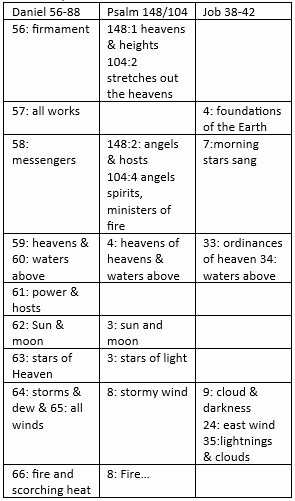
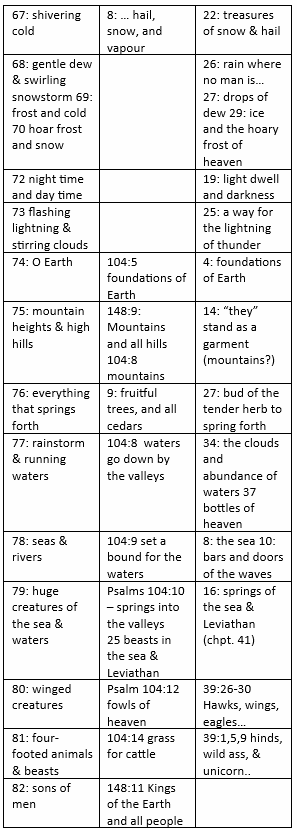
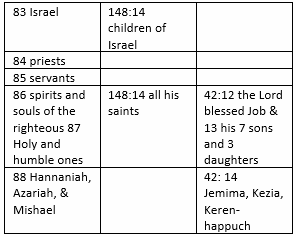
The three Hebrew children weren’t in a hurry to say “thank God for the gentle dew”, but went methodically down the list from the highest point of Creation down to the lowest and most personal, the saint himself, or his very life itself.
88 – out of Hades – returning us back to the beginning of the dialogue that stated God could go anywhere to save His children even Hades where the demons are held.
Luke 16:23 (KJV 1900)
23 And in hell he lift up his eyes, being in torments, and seeth Abraham afar off, and Lazarus in his bosom.
86 ᾅδης [hades /hah·dace/] n pr loc. From 1 (as negative particle) and 1492; TDNT 1:146; TDNTA 22; GK 87; 11 occurrences; AV translates as “hell” 10 times, and “grave” once. 1 name Hades or Pluto, the god of the lower regions. 2 Orcus, the nether world, the realm of the dead. 3 later use of this word: the grave, death, hell. Additional Information: In Biblical Greek it is associated with Orcus, the infernal regions, a dark and dismal place in the very depths of the earth, the common receptacle of disembodied spirits. Usually Hades is just the abode of the wicked, Lu. 16:23, Rev. 20:13,14; a very uncomfortable place. TDNT.[1]
90 – all those who worship the Lord – After exhausting the list of those who can and should worship the Lord from any time, space, or dimension, Azariah concludes that all should praise the Creator of the Universe accordingly by praising Him with His own Words in the Bible itself, such as Psalms 104, 148, and Job 38-42.
91 – alive – This must have been an astonishing feeling for Nebuchadnezzar who thought he himself was a god, with the power to kill and make alive, only to see he is nothing, and knows nothing of the true God, like Job felt in 38-42.
92 messenger – angel in Greek. He looks supernatural to the puzzled Nebuchadnezzar. Not having any Scriptural basis to know WHO the “angel of the Lord” actually was, possibly Jesus Himself like when Moses met Him.
Exodus 3:2 (KJV 1900)
2 And the angel of the Lord appeared unto him in a flame of fire out of the midst of a bush: and he looked, and, behold, the bush burned with fire, and the bush was not consumed.
93 door – This was an entrance into the furnace, and is used of the name of him who brings salvation, which is Jesus (Behold I stand at the door and knock: if any man hear my voice, and open the door, I will come in to him, and will sup with him, and he with me. Rev. 3:20)
2374 θύρα [thura /thoo·rah/] n f. Apparently a root word [cf “door”]; TDNT 3:173; TDNTA 340; GK 2598; 39 occurrences; AV translates as “door” 38 times, and “gate” once. 1 a door. 1a the vestibule. 1b used of any opening like a door, an entrance, way or passage into. 1c in a parable or metaphor. 1c1 the door through which sheep go in and out, the name of him who brings salvation to those who follow his guidance. 1c2 “an open door” is used of the opportunity of doing something. 1c3 the door of the kingdom of heaven (likened to a palace) denotes the conditions which must be complied with in order to be received into the kingdom of God.[1]
94 scent of fire – Just like when antichrist arrives to Earth and begins the tribulation of satan, none of his attacks will touch God’s elect (who have the seal of God in their forehead), not their clothes, their hair (Luke 21:18), not their bodies, nor their sandals. His deceptive words cannot permeate their mind or change their mind in any way.
95 – gave over their bodies for the burning – They were offering themselves up for the sins of the people, but Jesus stopped them from dying because He is the ultimate salvation for the people, the perfect Lamb slain.
96 impiously – Kind of showing those will blaspheme God during the tribulation as well, will regret it, and lose everything (robes of righteousness).
987 βλασφημέω, δυσφημέω [blasphemeo /blas·fay·meh·o/] v. From 989; TDNT 1:621; TDNTA 107; GK 1059 and 1555; 35 occurrences; AV translates as “blaspheme” 17 times, “speak evil of” 10 times, “rail on” twice, “blasphemer” once, “speak blasphemy” once, “blasphemously” once, and translated miscellaneously three times. 1 to speak reproachfully, rail at, revile, calumniate, blaspheme. 2 to be evil spoken of, reviled, railed at.[2]
97 – granted – King Nebuchadnezzar would grant them authority until his son Beltashazzar would come, and they would soon forget this whole event and go back to worshipping false gods (see chpt. 5).
98 – This verse starts chapter 4 in the King James Bible (and most translations).
99 – signs and wonders – The great conclusion to the event of them surviving the fiery furnace, but also all the creations of God (mentioned by the three Hebrew children) that bring more glory and honor to His name. It fits better here at the end of chapter 3 as the great conclusion, PRAISE GOD MOST HIGH.
100 – from generation to generation – God’s authority and might should be passed on from generation to generation if men were not negligent in telling their children the mighty works of God.
n n: noun or neuter
f f: feminine
TDNT Theological Dictionary of the New Testament
TDNTA Theological Dictionary of the New Testament, Abridged in One Volume
[1] Strong, J. (1995). In Enhanced Strong’s Lexicon. Woodside Bible Fellowship.
v v: verb
TDNT Theological Dictionary of the New Testament
TDNTA Theological Dictionary of the New Testament, Abridged in One Volume
[2] Strong, J. (1995). In Enhanced Strong’s Lexicon. Woodside Bible Fellowship.
n n: noun or neuter
pr pr: proper or pronoun
loc loc: locative
TDNT Theological Dictionary of the New Testament
TDNTA Theological Dictionary of the New Testament, Abridged in One Volume
[1] Strong, J. (1995). In Enhanced Strong’s Lexicon. Woodside Bible Fellowship.
v v: verb
[1] Strong, J. (1995). In Enhanced Strong’s Lexicon. Woodside Bible Fellowship.
v v: verb
TDNT Theological Dictionary of the New Testament
TDNTA Theological Dictionary of the New Testament, Abridged in One Volume
[2] Strong, J. (1995). In Enhanced Strong’s Lexicon. Woodside Bible Fellowship.
n n: noun or neuter
f f: feminine
TDNT Theological Dictionary of the New Testament
TDNTA Theological Dictionary of the New Testament, Abridged in One Volume
[1] Strong, J. (1995). In Enhanced Strong’s Lexicon. Woodside Bible Fellowship.
v v: verb
TDNT Theological Dictionary of the New Testament
TDNTA Theological Dictionary of the New Testament, Abridged in One Volume
[2] Strong, J. (1995). In Enhanced Strong’s Lexicon. Woodside Bible Fellowship.
v v: verb
TDNT Theological Dictionary of the New Testament
TDNTA Theological Dictionary of the New Testament, Abridged in One Volume
[3] Strong, J. (1995). In Enhanced Strong’s Lexicon. Woodside Bible Fellowship.
adj adj: adjective
[1] Strong, J. (1995). In Enhanced Strong’s Lexicon. Woodside Bible Fellowship.
v v: verb
[2] Strong, J. (1995). In Enhanced Strong’s Lexicon. Woodside Bible Fellowship.
[1] Bullinger, E. W. (2018). The Companion Bible: Being the Authorized Version of 1611 with the Structures and Notes, Critical, Explanatory and Suggestive and with 198 Appendixes (Vol. 1, p. 1180). Faithlife.
[2] Smith, W. (1986). In Smith’s Bible Dictionary. Thomas Nelson.
[3] Smith, W. (1986). In Smith’s Bible Dictionary. Thomas Nelson.
n n: noun or neuter
f f: feminine
TDNT Theological Dictionary of the New Testament
TDNTA Theological Dictionary of the New Testament, Abridged in One Volume
[1] Strong, J. (1995). In Enhanced Strong’s Lexicon. Woodside Bible Fellowship.