
THE BOOK OF DANIEL
INTRODUCTION
According to the Septuagint OLD GREEK manuscripts, kept hidden from English eyes for thousands of years until 2012!
This is a presentation of the book of Daniel with commentary to help establish the timing of the book, and historical context. I also look at the themes and usage of different words used in context. The translation is from Logos Bible Software where it is called the Lexham English Septuagint (LES - copied with permission from Logos Bible Software).
Brannan, R., Penner, K. M., Loken, I., Aubrey, M., & Hoogendyk, I., eds. (2012). The Lexham English Septuagint (Da 2:35). Lexham Press.
Introducing the book of Daniel from the original manuscripts written and recorded by Origen (a Biblical scribe) back in 331 AD. Unfortunately, this original transcription of the Septuagint was not favored by the early Christians, and neither by the Jews of the day, who were part of the Arian heresy. They disliked the idea that Jesus Christ was the Messiah and tried to discredit Him by changing the certain parts of the Septuagint Bible. One important component of the Septuagint was it’s dating system from Adam. In Genesis 5 and 11 the patriarch’s ages are given which dates Adam to about 5500 BC. This would put Christ at the 6th millennium from Adam, and since Christ is the 2nd Adam:
47 The first man is of the earth, earthy: the second man is the Lord from heaven.
1 Corinthians 15:47
And Adam, or man in general, was created on the 6th day of creation, then the creation week would be predicting the arrival of the Messiah EXACTLY at the correct timing from Adam, i.e. 6,000 years. So you can see WHY they wanted to change any dating in the Septuagint that pointed to Jesus Christ as the Messiah. They actually admit to these changes in their book written in 160 AD, called the Seder Olam. Naturally, the book of Daniel was a huge target because it contained the famous 490 year prophecy from the building of the streets of Jerusalem, which was a known date of 458 BC, the 7th year of Artaxerxes mentioned in Ezra 7:7. When you add 490 years you get exactly the date of the crucifixion and resurrection in 33AD.
This was a huge arrow pointing to Jesus Christ as the true Messiah that the Bible predicted in type and time. Because of this, Origen got together with a scribal friend named Theodotion who was commissioned to " recast the Septuagint with a FREE HAND" (Jewish Encyclopedia online).
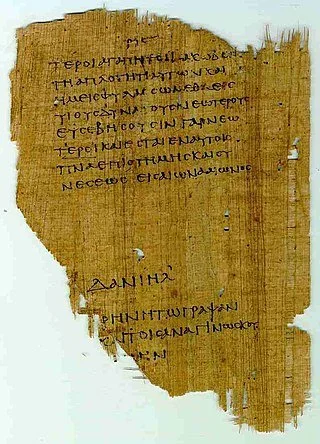
PAPYRUS 967 (DISCOVERED 1931)
From Wikipedia under “Theodotion”: Theodotion's translation was so widely copied in the Early Christian church that its version of the Book of Daniel virtually superseded the Septuagint's. The Septuagint Daniel survives in only two known manuscripts, Codex Chisianus 88 (rediscovered in the 1770s), and Papyrus 967 (discovered 1931). Jerome, in his preface to Daniel (407 CE), records the rejection of the Septuagint version of that book in Christian usage: "I ... wish to emphasize to the reader the fact that it was not according to the Septuagint version but according to the version of Theodotion himself that the churches publicly read Daniel."[1] Jerome's preface also mentions that the Hexapla had notations in it, indicating several major differences in content between the Theodotion Daniel and the earlier versions in Greek and Hebrew. However, Theodotion's Daniel is closer to the surviving Hebrew Masoretic Text version, the text which is the basis for most modern translations. Theodotion's Daniel is also the one embodied in the authorised edition of the Septuagint published by Sixtus V in 1587.[2]
1. Jerome, Commentary on Daniel Archived 2010-05-26 at the Wayback Machine, translated by Gleason L. Archer (1958), accessed 5 January 2019
2. ^ Catholic Encyclopedia (1913)
Theodotion’s copy is the main translation that is put in ALL MODERN VERSIONS including most Septuagint translations! Therefore, I have chosen the Lexham English Septuagint for the book of Daniel as it contains the English translations of the original manuscripts (Codex Chisianus 88, Papyrus 967, and the Syro-hexapler).
All twelve Chapters of Daniel in this work are from the Lexham English Septuagint (LES), and noted at the footnote of each page.
Many of the chapters are almost the same as the King James Version except some obvious discrepancies in the KJV are cleared up in the LES, like verses completely out of context (like Daniel 5:18-21 where it belongs in chapter 4. Chapter 4 is severely mangled, in my opinion, in the KJV, but the LES gives us the entire dream of the king, and then gives us the interpretation.) Theodotion did some serious damage to Daniel chapter 9, by simply cutting out over half of Daniel 9:27, and changing “many weeks” to “one week”. This error will create an incoherent “gap” of 2,000 years in Daniel’s timeline which actually goes all the way to the end of the age, symbolized by the toes in the statue of chapter 2. The book of Daniel would go from paleo-Hebrew to Syriac (chpt. 2) and back to Hebrew (chpt. 8). Many targums were written at this time, which were paraphrases of the Bible. The paleo Hebrew scrolls would later be preserved at the Library of Alexandria in Egypt to be translated in 250 BC in the Greek language. This version of Daniel that I have reprinted here is considered the “Old Greek” version and has been hidden from English readers for almost 2,000 years until it was published in English in 2012.
Summary of the Book of Daniel
The book of Daniel begins with Gentile rulers ruling over Jerusalem in 604/3 BC. Daniel’s prophecy in chapter two predicts that the rulership over Jerusalem will continue to be Gentile nations for about 2600 years right up until the Lord returns to Earth and destroys ALL rulership upon His return (symbolized by the great stone that destroys the statue in Daniel 2:45).
Daniel is dated 604 BC (Daniel 1:1) when Nebuchadnezzar sieged Jerusalem. Although “Jewish” reckoning marked that year 604/3 BC as year 1 of Nebuchadnezzar (His accession year), it was technically the 21st year of Nabopolassar. You can see the Babylonian reckoning of years in Jeremiah 52:28 where it refers to the 2nd siege of Nebuchadnezzar (during Jehoiakim’s reign) as the 7th year, even though the Hebrew reckoning was the 8th year (see 2 Kings 24:12, Jer. 52:28).
This date, 604/3 BC (the 1st siege of Nebuchadnezzar) is very important because all of Daniel’s prophecies are going to start in that year. The Hebrew year began in April or September depending if it was a religious or civil year being reckoned; therefore, the proper way to refer to “one year” is with a slash “/” mark. Often when you are counting years of Hebrew prophecy this must be noted along with which “start” of the year you are counting from (spring or fall), but never starting in January. Archaeology corroborates this timeline with the Harran Inscription (where Nebuchadnezzar ascends the throne in the 21st year of Nabopolassar. See picture on the next page). It is also interesting to note that Daniel is counting the years of Nebuchadnezzar only in the Septuagint version in Daniel 3:1 is the 18th year of Nebuchadnezzar noted (Babylonian reckoning, but 19th yr in Hebrew reckoning).
The themes of Daniel build upon each other from chapter 1 to 12. You start with the statue of a man in chapter two, representing human authority and power of empires. The vision predicts how human authority will get weaker and weaker over the expanse of time (given in chapter 12 as 1290 + 1335 “days” or years). The vision only applies to the rulership of Jerusalem from head to toe, but becomes significantly weaker and less likely to hold power and authority in the “toes” portion of the statue. We see the theme throughout Daniel on into chapter 5, where it is stated that God will “number, weigh, and divide” this kingdom of Babylon continually fracturing its power until it’s completely obliterated by the arrival of the true and rightful King of kings, pictured by the “stone made without hands” in Daniel 2:45.
The vision of the statue establishes that God is counting, numbering, and dividing each kingdom more and more until it’s barely held together by two elements that do not mix, iron and clay.
THE HARRAN INSCRIPTION
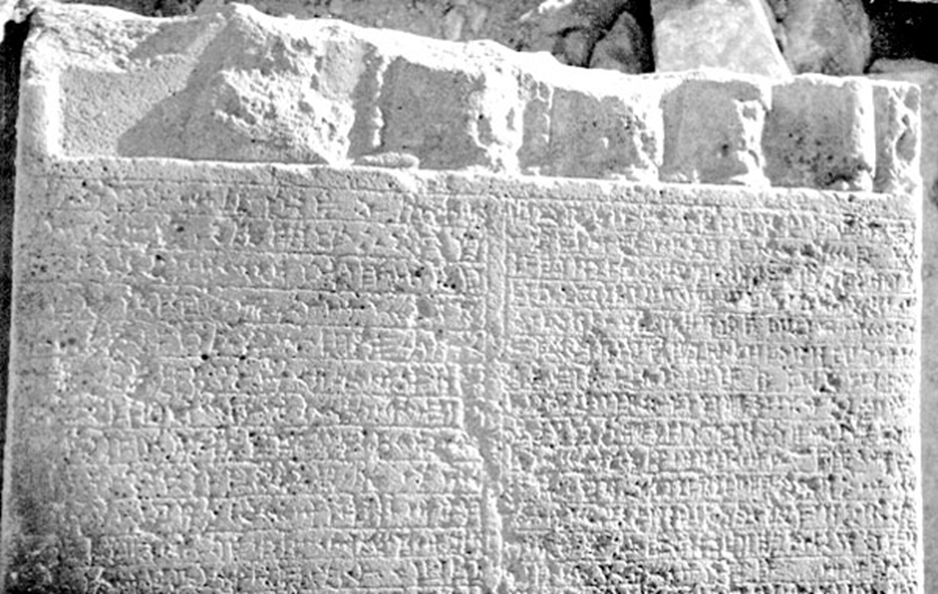
In August-September of 1956 Dr. D.S. Rice made an important discovery at the Harran site. Rice was examining the ruins of a medieval mosque when he discovered some Babylonian Stele with inscriptions dating back to the sixth century BC.
The stele were turned face down and used as steps at the North, East and West entrances to the Mosque. The inscriptions were by the Babylonian ruler, Nabonidus and his mother during the time of Daniel’s captivity.
https://www.bibliotecapleyades.net/sitchin/Adda_Guppi_Harran.htm
Ptolemy’s Almagest (150 AD) – records the lunar eclipse of 621 BC (which occurred in the 3rd yr of Nabopolassar)
King Accession Year First Year
B.C. B.C.
Nabopolassar . . . . . . . . . . . . . . 624 623 * 621 BC lunar eclipse
Nebuchadnezzar II . . . . . . . . . . . 603 602
Awel-Marduk . . . . . . . . . . . . . . 560 559
Neriglissar . . . . . . . . . . . . . . 558 557
Labashi-Marduk . . . . . . . . . . . . 554 -----
Nabonidus . . . . . . . . . . . . . . 554 553
Cyrus (Persian Emperor) . . . . . . . . 537 536
Diodorus (an historian in ch. 24, s. 2) – says Nabopolassar “was the most distinguished of the priests whom the Babylonians call Chaldeans. In virtue of his singular proficiency in astrology and soothsaying he used to foretell the future to the multitude infallibly and had already acquired a reputation thereby when he predicted to his friend the Median general, that he must of a surety become king of all the lands that Sardanapallus (Sin-shar-ishkun)(which is the Assyrian King) ruled.”
6 months later after the eclipse of 621 BC, Babylonian advances against Assyria began, and this is the foundation for not only the TIMING of the book of Daniel, but the standard of prophecy that was set before Daniel came on the scene in 604 BC, the first siege of Jerusalem by Nebuchadnezzar (before he officially ascended to the throne).
621 BC would also be the 16th Jubilee recorded by historians.
This date (621 BC, the 16th Jubilee) will establish the Jubilee cycle (every 49 yrs) in the heavens and Biblical chronology.
Civil years started
IN THE FALL (ESPECIALLY the Jubilee years)
1454 1453 Exodus: They exited Egypt in the SPRING of 1453
1414 1413 Jordan
1405 1404 Land Division to 7 tribes
1 1356 1355
2 1307 1306
3 1258 1257
4 1209 1208
5 1160 1159
6 1111 1110
7 1062 1061
8 1013 1012
9 964 963 Acts 13:20 450 yrs fr. Jordan, Ezekiel’s 380 yrs LXX
10 915 914
11 866 865
12 817 816 Israel’s two injustices, Ezek. 4:4-6 LXX
13 768 767
14 719 718
15 670 669
16 621 620 King Josiah's Great Passover Historically Recorded
17 572 571 Historically recorded by Jews in Babylon
In Adam Ruthorford’s “Bible Chronology” (p. 15) Rutherford states, “Darius the Great (Darius I) whose long reign is astronomically fixed by the historical record of the occurrence of two eclipses--- a lunar eclipse on 19th November 502 BC in the 20th year of his reign and another lunar eclipse on 25th April, 491 BC in the 31st yr, both of which have been confirmed by modern astronomical computation as absolutely correct.”
This fixes the timeline of Daniel, astronomically from start to finish including the Ezra/Nehemiah period that follows Daniel. The Persian kings that follow Cyrus about 203 years from 534 BC to 331 BC, when Alexandar the Great defeats the Persians and becomes the next stage in Daniel’s statue (the waist of Brass) that would subsequently split into 4 kingdoms, making 5 kingdoms total for the Brass portion of the Statue (Syria, Egypt, Turkey, and Rome).
The legs are the Ottoman Empire and described in Daniel 11:36-45, including the mosque they built in Jerusalem (vs. 45) exactly 1290 years after the 1st siege on Jerusalem by Nebuchadnezzar in 604 BC. 1290 years after 604 BC is 688 AD, exactly when that type of “abomination of desolation” was set up, again that was just a type, of what would occur in days in the future of the antichrist himself, DEFACTO.